


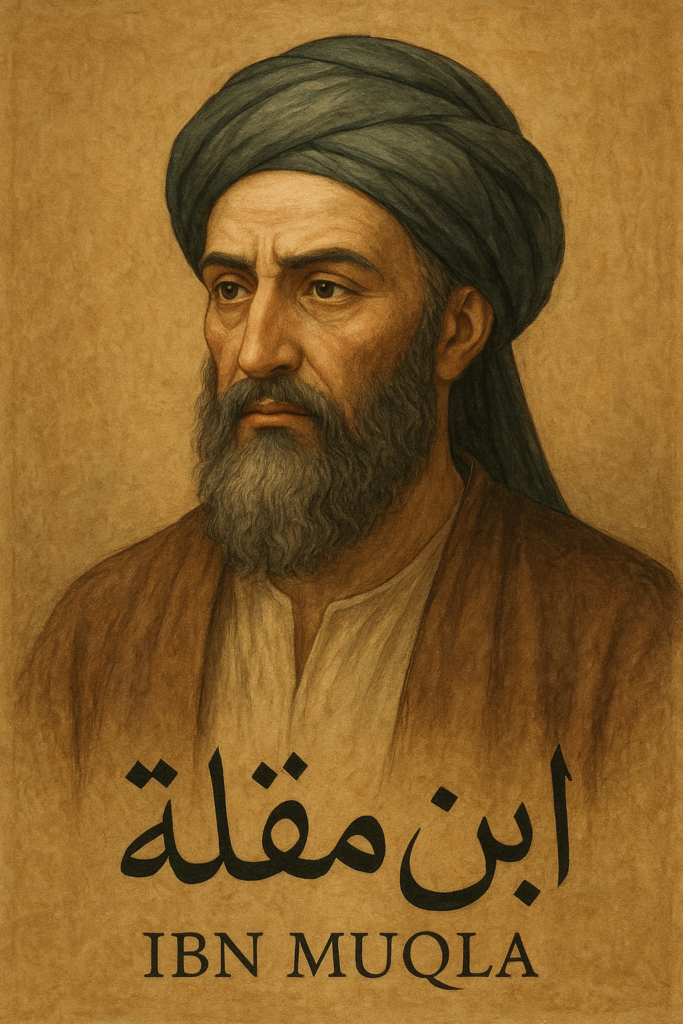
Abu Ali Muhammad ibn Ali ibn Muqla (885/6 – July 20, 940/1 CE) was a prominent Abbasid official and a foundational figure in the history of Arabic calligraphy. He served three non-consecutive terms as vizier during one of the most turbulent periods in the Abbasid Caliphate, witnessing and attempting to manage the collapse of centralized authority. Beyond his political career, Ibn Muqla is most celebrated for revolutionizing Arabic script, laying the foundations of modern Islamic calligraphy.
Early Life and Rise to Power
Born in Baghdad in 885/6 CE (AH 272), Ibn Muqla began his career as a tax collector, quickly advancing through the ranks of the civil administration. His talents were recognized by the influential vizier Abu’l-Hasan Ali ibn al-Furat, who appointed him to manage official correspondence.
During the chaotic reign of Caliph al-Muqtadir (r. 908–932), Ibn Muqla navigated a complex political environment dominated by rival factions: the Banu al-Furat, the Banu al-Jarrah, and powerful military commanders like Mu’nis al-Khadim. Despite shifting alliances, Ibn Muqla remained a significant player, eventually gaining control of the Diwan al-Diya‘ (Department of Public Estates) under Vizier Ali ibn Isa al-Jarrah.
First Term as Vizier (928–930)
In 928, with support from court chamberlain Nasr, Ibn Muqla became vizier. His first term, however, was marred by internal instability. A coup attempt in 929, led by Mu’nis al-Khadim, temporarily replaced al-Muqtadir with his brother al-Qahir. Though the coup failed, it weakened Ibn Muqla’s position, and he was removed from office in 930 as Mu’nis and Ali ibn Isa regained control.
Second Term and the Fall of al-Qahir (932–933)
After al-Muqtadir was killed in battle in 932, his successor, al-Qahir, reinstated Ibn Muqla as vizier. But the new caliph proved autocratic and soon alienated his ministers. Ibn Muqla and others conspired against him. The following year, al-Qahir was arrested, blinded, and deposed, paving the way for the caliphate of al-Radi.
Third Term and Final Fall (934–936)
Initially reluctant, al-Radi eventually reappointed Ibn Muqla as vizier after the aging Ali ibn Isa declined the role. Although the vizierate was his once more, real power remained in the hands of military commanders, particularly Muhammad ibn Yaqut—until his fall in 935.
Ibn Muqla’s ambitions now turned toward restoring central authority. He launched a military campaign against the Hamdanids in the Jazira region and temporarily seized Mosul. However, he was forced to return to Baghdad and failed to follow through with further action against the rebellious governor Ibn Ra’iq. This failure, alongside worsening financial conditions, led to his final dismissal in 936.
Imprisonment and Death
With his removal, Ibn Muqla’s political career ended, and a new era began: Ibn Ra’iq was appointed amir al-umara (“commander of commanders”)—a title that effectively turned the caliph into a figurehead and transferred real power to military leaders.
Ibn Muqla attempted to conspire against Ibn Ra’iq but was discovered. He was imprisoned, had his right hand severed, and later his tongue cut out. Although the Turkish general Bajkam soon overthrew Ibn Ra’iq, Ibn Muqla remained in prison, where he died on July 20, 940.
Legacy in Arabic Calligraphy
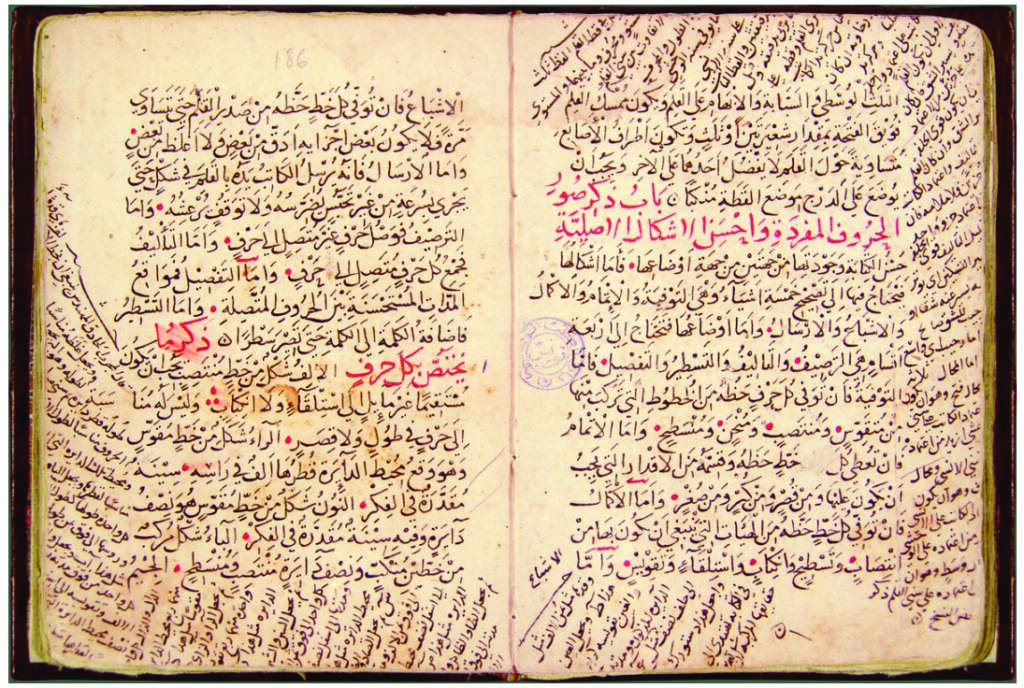
Despite the tragic end to his political life, Ibn Muqla is immortalized through his monumental contributions to Islamic calligraphy.
He is credited with inventing or formalizing several script styles, most notably:
- Thuluth (خط الثلث) – a large, elegant, and decorative script.
- Naskh (نسخ) – a simpler, more readable style that eventually replaced the Kufic script as the primary script for writing the Qur’an.
Ibn Muqla also introduced the concept of al-khatt al-mansub (“proportioned script”), a system that linked the design of each letter to geometric principles using:
- the nuqta (dot) as a measurement unit,
- the height of the alif (ا),
- and a circle whose diameter matched the alif’s height.
Although none of his original manuscripts survive, later scholars, especially Ibn al-Bawwab, built upon his work, and his theories became the cornerstone of classical Arabic calligraphy.
Conclusion
Ibn Muqla’s life was marked by ambition, brilliance, and tragedy. As a vizier, he navigated a crumbling empire and watched firsthand as the Abbasid caliphs lost real power to military strongmen. But while his political legacy was marred by failure and imprisonment, his innovations in calligraphy changed the visual culture of Islam forever.
He remains a symbol of both the political decline and the artistic flourishing of the Abbasid Golden Age.