


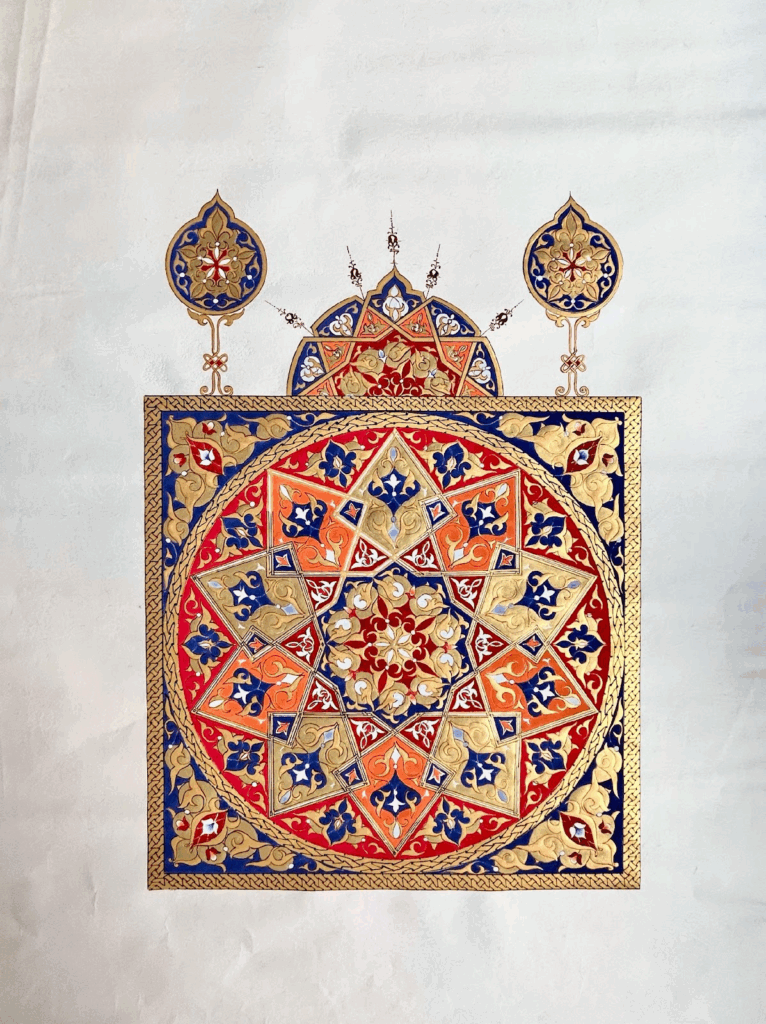
This artwork is a refined example of Moroccan illumination—a traditional art that blends precise geometry, rich ornamentation, and symbolic color. It reflects the timeless heritage of Islamic art, where harmony between mathematics and beauty creates patterns that evoke both the material and the spiritual world.
Central Geometry
At the heart of the design lies a ten-pointed star, a celebrated form in Moroccan and Islamic geometry. The tenfold structure radiates outward with interlocking polygons and triangular forms, creating a dynamic sense of rotation and balance. The star is enclosed within a circular medallion, which itself is framed by a square border. This union of circle and square carries symbolic meaning: the circle represents eternity and the heavens, while the square reflects stability and the earthly realm—together embodying harmony between the divine and human experience.
Color Palette & SymbolismThe brilliance of this piece is revealed through its vivid colors, chosen not only for visual beauty but also for symbolic depth.
- Gold: Richly applied in outlines and arabesques, gold symbolizes divine light, nobility, and the sacred. In Moroccan illumination, gold often highlights the most important features of a design.
- Red: Filling the star’s triangular points and background fields, red conveys vitality, strength, and passion. It is a grounding warmth that commands attention.
- Blue: A deep, calming blue fills many floral motifs and negative spaces. In Islamic art, blue signifies spirituality, peace, and the infinite sky and sea.
- White & Ivory tones: Used inside arabesque motifs, they soften the contrast of stronger colors, symbolizing purity and clarity.
- Black outlines: Thin dark lines carefully separate colors, providing definition, order, and sharpness—essential for geometric precision.
The interplay of warm (red, gold) and cool (blue, white) tones creates balance: warmth radiates from the center, while coolness stabilizes the composition at the edges.
Ornamental Details
Within the ten-pointed star and surrounding polygons are arabesque vegetal patterns—stylized leaves, vines, and blossoms known as islimi. These flowing motifs symbolize eternal growth, life, and divine creativity, seamlessly woven into the geometric framework.
The border is richly decorated with a woven interlace, enclosing the central medallion like a frame of protection. Interlace patterns, with no beginning or end, symbolize unity, continuity, and the infinite nature of creation.
Top Extensions
Above the square border rise three elegant finials:
- A large arched crown in the center, filled with gold foliage and geometric forms, symbolizing elevation and grandeur.
- Two teardrop medallions on either side, symmetrically balanced, each filled with golden arabesques against deep blue backgrounds. These provide harmony and refinement, echoing manuscript illuminations found in Qur’anic frontispieces.
These elements give the artwork an architectural presence, as though the design itself rises upward like a sacred structure.
Artistic Style
This piece reflects the tradition of Moroccan zakhrafa (ornamentation) and tastīr (illumination/linework), where geometric accuracy, ornamental detail, and color symbolism are combined. The artist demonstrates:
- Mathematical mastery in constructing the ten-point star and its subdivisions.
- Ornamental elegance through arabesque flourishes that soften the geometry.
- Luxurious refinement with rich pigments and the brilliance of gold.
The result is an artwork that is both scientifically ordered and spiritually expressive, a visual harmony between logic and beauty.
Conclusion
This Moroccan illuminated design, centered on a ten-pointed star, is more than decorative art—it is a symbolic expression of harmony, spirituality, and timeless craftsmanship. The careful geometry anchors the work in mathematical truth, the colors carry cultural and spiritual meanings, and the arabesque details bring life and movement to the pattern. Crowned with ornamental finials, it stands as a glowing example of Morocco’s artistic legacy, where zakhrafa and tastīr meet in perfect unity.
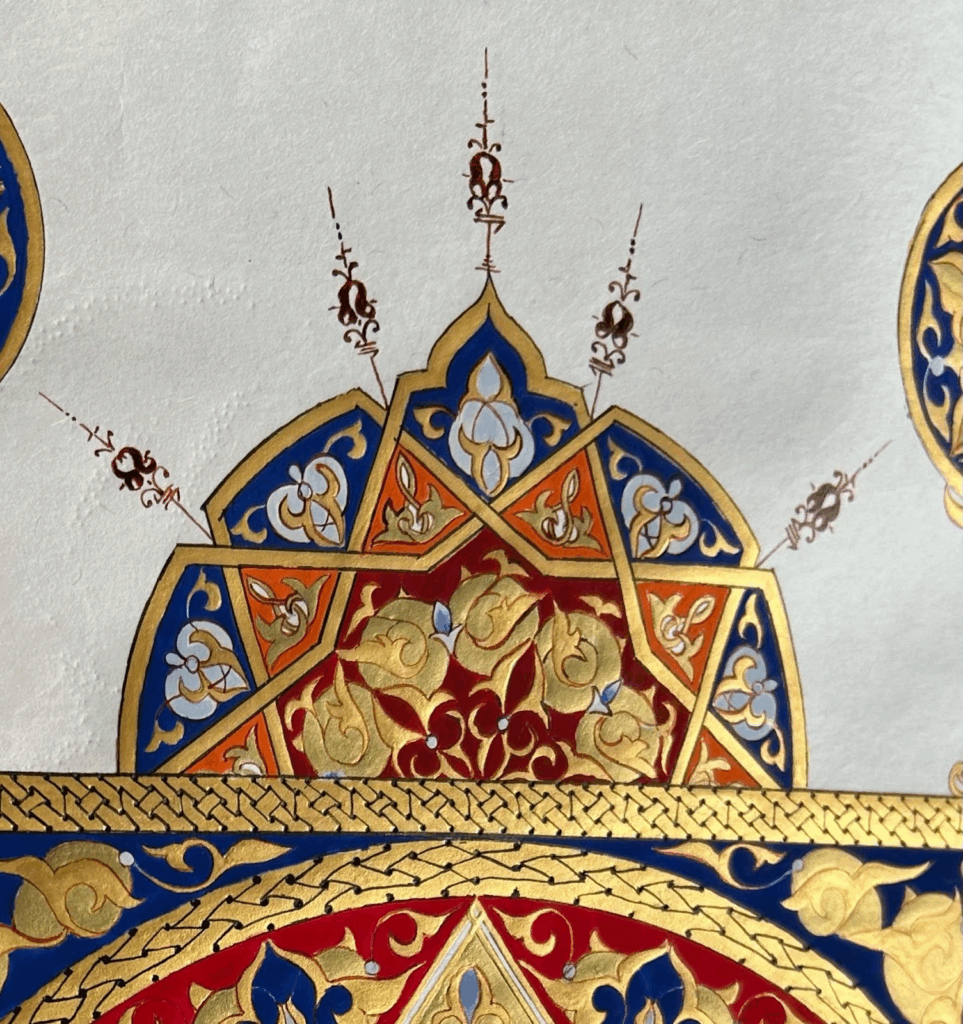
The Kubba (Crown Element)The Kubba (قبة) is a distinctive ornamental crown in Moroccan zakhrafa and tastīr, often placed above central medallions or manuscript headings.
Structure & Geometry:
This Kubba is built from the geometry of atwelve-pointed star, which has been expanded into an ambolism:
Gold: Dominates the arabesques, symbolizing divine light and sacred beauty.
Red: Fills triangular star fields, adding vitality, warmth, and strength.
Blue: Frames the motifs, giving depth and evoking spirituality.
White details: Highlight blossoms and leaves, symbolizing purity and clarity.
The palette creates a dynamic balance of warmth (gold and red) with coolness (blue and white), making the Kubba radiant and elevated.
Ornamentation:
Within the twelve divisions, arabesque foliage (islimi) flows in gold, representing eternal growth and divine creativity. The geometric order of the star blends seamlessly with organic curves, showing the harmony of science and art.
Extensions:
Rising above the Kubba are delicate tughra-like linearrch-like crown. The twelve divisions create perfect symmetry, radiating balance and harmony. Its pointed apex rises upward, resembling the dome of a shrine or the crown of a sacred manuscript page.
Color & Sy ornaments, finely drawn in brown-red ink. These add elegance, movement, and height, emphasizing the Kubba’s role as a crown.
Function & Meaning:
In Moroccan manuscripts, such Kubbas crowned surah headings or decorated the tops of pages. They symbolize spiritual elevation, echoing the domes of mosques and the heavenly sphere. The twelve-pointed star at its base connects the crown to celestial order and divine harmony.
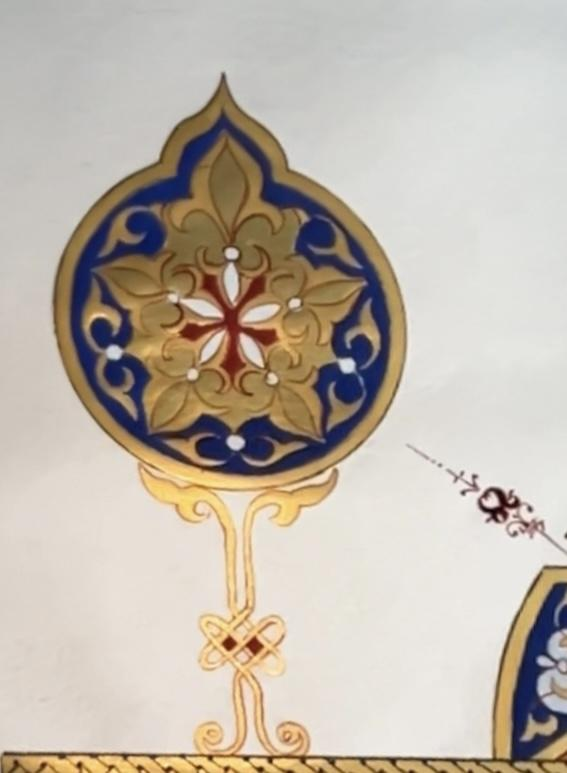
This element is a small ornamental medallion often used in Moroccan zakhrafa and tastīr to complement larger designs.
Shape: A teardrop-like outline with a rounded body and pointed tip, giving it elegance and balance.
- Centerpiece: A red six-petaled floral star surrounded by white almond-shaped leaves, radiating symmetry.
- Decoration: Gold arabesque foliage fills the interior, framed by a deep blue background with small white highlights.
- Support: The medallion rests on a golden stem with an intricate knot motif, recalling manuscript illumination styles.
✨ In short:
This medallion is a jewel-like ornament, combining red, gold, blue, and white in a harmonious floral pattern, symbolizing refinement and balance within Moroccan illumination.

