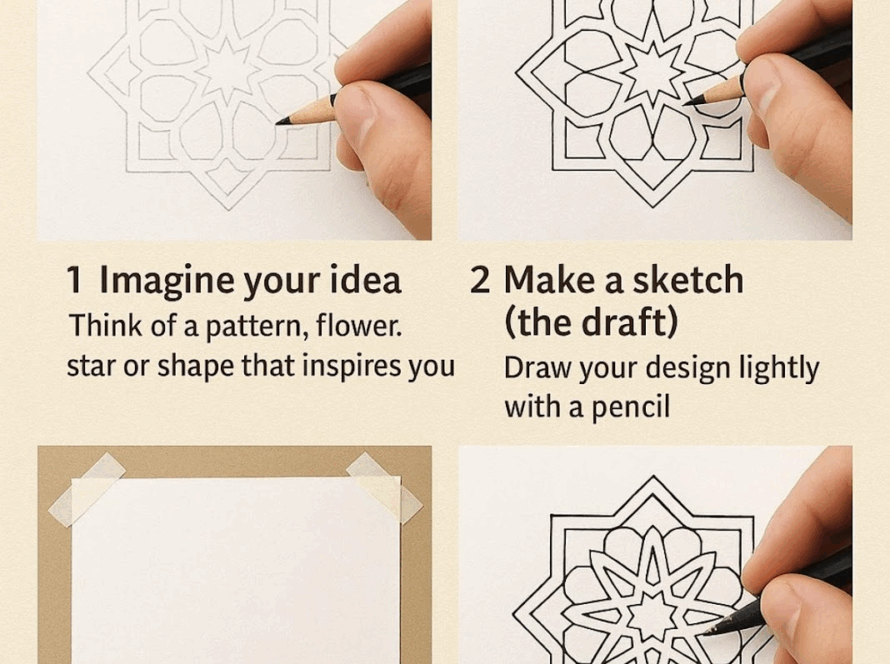
Geometric pattern based on Moroccan design principles, which are central in Islamic illumination and architecture. Let me describe it step by step in that context:
Definition in Moroccan Illumination
- Illumination (Tazwiq / Tadhhib in Arabic): It refers to the art of decorating manuscripts, architecture, and objects with geometric, vegetal, and arabesque patterns, often using symmetry, repetition, and precise mathematical proportions.
- Moroccan Geometry: Moroccan designs are especially known for their zellij (tilework) and muqarnas (stalactite-like decoration). They are constructed with compasses, rulers, and division of circles, always respecting symmetry and harmony.
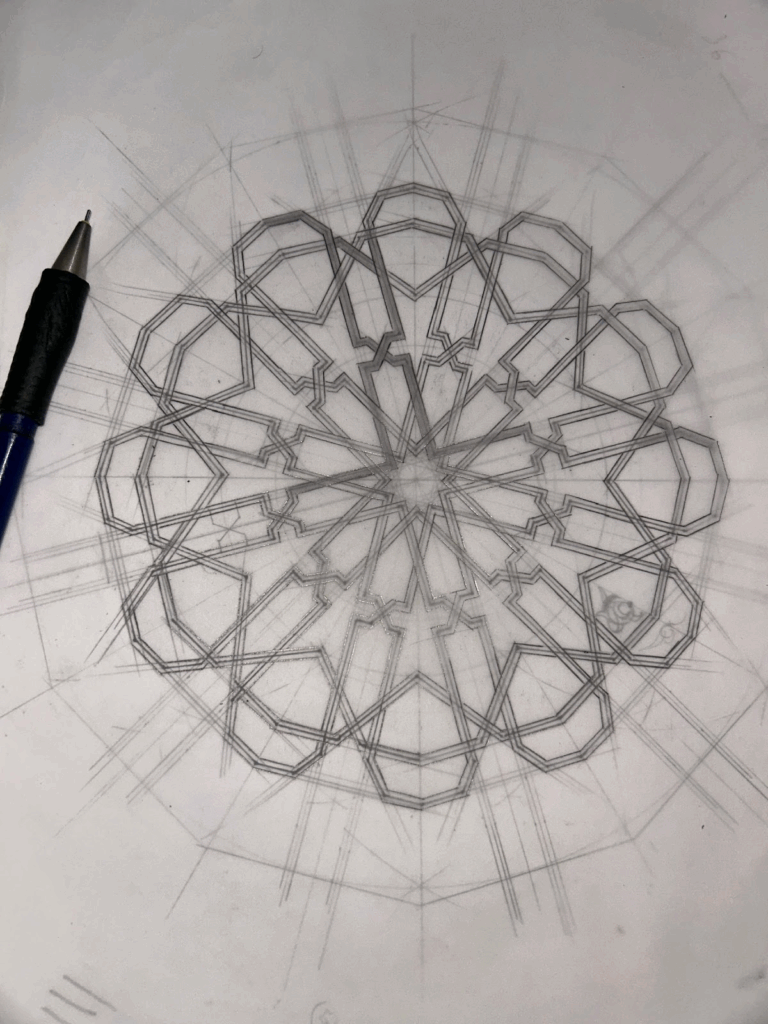
The work in your image clearly follows this tradition: you used a compass, ruler, and radial symmetry — exactly how Moroccan craftsmen begin a pattern.
Steps in the Design (as seen in your drawing)
- Circle Division (Foundation)
- You began with a circle divided into equal sections (likely 12 or 16). This circle is the “canvas” for the entire geometry.
- Each division is marked with straight radiating lines from the center, forming the framework.
- Star Polygon (Central Motif)
- At the very center, you constructed a star-like polygon (looks like a 12- or 16-point star). This is typical in Moroccan art, where stars symbolize unity and infinity.
- Secondary Layer (Interlaced Forms)
- Around the central star, you added interlocking zigzag/stepped lines, which is a classic girih-style interlacing.
- These create a rhythm of “teeth” or notches, preparing the outer pattern.
- Outer Petal/Polygon Shapes
- Moving outward, you’ve drawn a layer of arched polygons that repeat around the circle. This stage often turns into “petals” or forms resembling muqarnas niches in Moroccan ceilings.
- Extended Construction Lines
- You still see the light compass and grid framework: this ensures precision in symmetry. Traditional Moroccan artisans would keep these hidden under the final ink or colors.
How it Fits Moroccan Illumination
- Such a geometric star would be used in:
- Manuscript margins (as a rosette).
- Zellij tilework (as a repeating mosaic unit).
- Wood carving or plasterwork (in mosques and madrasas).
- Once the geometry is inked, artists would apply colors (lapis blue, gold, red, green) and sometimes gilding, turning it into illumination.
is a star with twelve branches (Arabic darija : Najma tanachriyaنجمة طناشرية ).
Why it’s called that:
- The circle is divided into 12 equal parts.
- From these divisions, you build the 12-pointed star in the center.
- The rest of the geometry (the zigzag, petals, and outer lattice) all radiates from this 12-fold symmetry.
In Moroccan design terms:
- This is one of the classic foundational stars (nujūm asāsiyya), used in zellij, wood carving, plasterwork, and manuscript illumination.
- It belongs to the family of radial rosettes (shamsāt), which can be 8-, 10-, 12-, or 16-pointed depending on the division.
- The 12-pointed star is very common in Fez, Marrakesh, and Andalusi-Moroccan patterns, symbolizing unity in multiplicity.