This remarkable piece of Moroccan illumination is more than an artwork; it is a tapestry of geometry, symbolism, and sacred beauty woven into color and form. Rooted in the centuries-old traditions of Islamic manuscript decoration, it exemplifies the Moroccan school of zakhrafa (ornamentation), where mathematical precision meets poetic devotion. The composition recalls the illuminated openings of Qur’anic manuscripts, where symmetry,repetition, and balance elevate the act of reading into a spiritual experience.
Geometry as the Language of the Divine
At the center of each panel lies a magnificent twelve-pointed star medallion, a hallmark of Islamic geometric art. The star bursts outward in rhythmic harmony, each petal-like segment interlaced with turquoise, sapphire, and emerald green. These colors, arranged with perfect balance, echo the cosmological symbolism of the star — a form representing both infinity and unity. In Islamic aesthetics, geometry is more than decoration; it is the visual embodiment of tawḥīd (oneness of God), revealing the perfection and order of creation.
The dual arrangement — two facing medallions divided by an intricate vertical band — mirrors the structure of an open manuscript. This is not coincidental: illumination in Morocco historically served to frame sacred texts, and here the artwork retains that same reverence for balance, proportion, and clarity. The mirrored design embodies the principle of reflection, suggesting that divine truth is revealed both outwardly in the universe and inwardly in the soul.
Ornamentation and Natural Motifs
Encircling the medallions are arabesques of intertwined vines, blossoms, and scrollwork, executed in layers of crimson, gold, and deep green. These vegetal motifs symbolize growth, renewal, and the eternal unfolding of life. Their continuous, non-ending curves represent infinity, reminding the viewer that creation is in perpetual motion.
Small circular medallions punctuate the composition, each filled with six- and eight-pointed stars, serving as anchors that guide the eye through the artwork. They function like pauses in a symphony, structuring the rhythm of the visual experience. Around the periphery, a lattice of gold filigree and delicate motifs creates a border of containment, ensuring that the central medallions radiate as the true focal points.
A Palette of Meaning
The color palette carries as much meaning as the geometry itself.
- Gold dominates, symbolizing divine light, eternity, and the sacred. It reflects illumination both literally and spiritually, linking the earthly with the transcendent.
- Emerald green, associated with paradise in Islamic tradition, brings vitality and peace to the design.
- Deep crimson injects warmth and grounding, evoking passion, power, and the beauty of life.
- Lapis blue and turquoise serve as celestial hues, recalling the heavens and infinite sky.
Together, these colors create a dialogue between heaven and earth, intellect and emotion, permanence and transience.
The Discipline of Craft
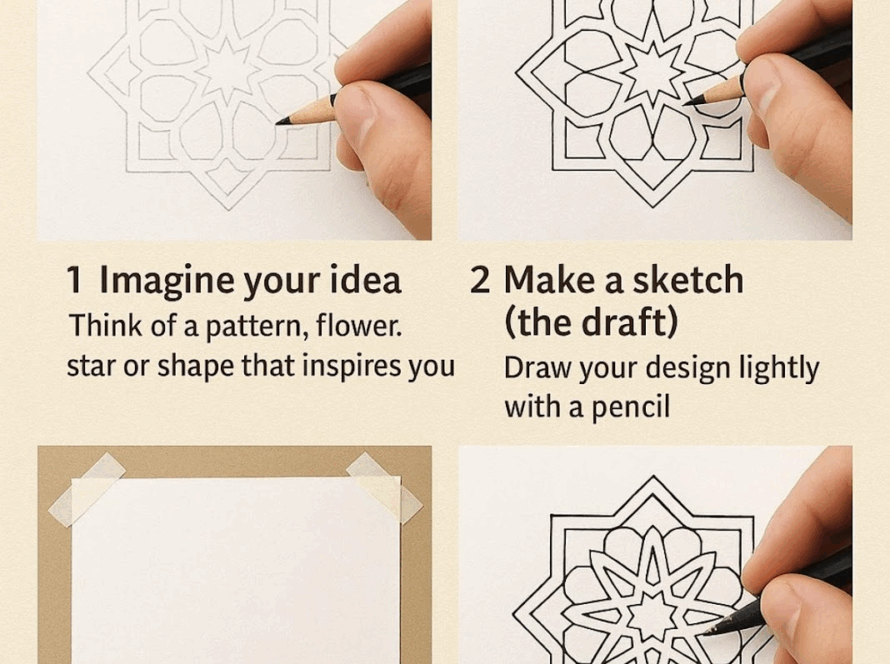
To produce such an illumination requires immense discipline, patience, and mastery of technique. The process begins with precise geometric construction, where compasses and rulers dictate the framework of symmetry. Each motif is carefully drawn, layered, and gilded, often with real gold leaf, which gives the artwork its brilliance. The artist’s hand must remain steady, not only in technical execution but also in spirit; illumination has historically been seen as a meditative practice, a form of devotion expressed through art.
The balance between zakhrafa (ornamentation) and tastīr (framing) is essential. Ornamentation fills the space with beauty and symbolism, while framing organizes it, providing clarity and structure. The harmony of these two disciplines is what transforms a decorative piece into a spiritual work of art.
Cultural and Spiritual Context
Illumination in Morocco is not isolated; it is part of a larger cultural heritage that spans manuscripts, architecture, and textile design. The symmetrical panels of this piece echo the decorated doorways and archways of Moroccan mosques and madrasas, where geometry and vegetal motifs converge to create spaces of contemplation. Just as architectural ornamentation elevates a building into a sanctuary, this illumination elevates a flat surface into a sacred visual experience.
Moreover, the work resonates with the philosophy of Islamic art, where beauty is not an end in itself but a path toward truth. The repetition of patterns, the symmetry of forms, and the careful calibration of color all point to a higher order — a divine reality that transcends the material world. In this way, the artwork is both deeply Moroccan and universally spiritual.

Conclusion
This illumination is not merely a decorative exercise but a profound expression of cultural identity, spiritual philosophy, and artistic mastery. It encapsulates the Moroccan tradition of uniting geometry, color, and ornamentation into a vision of balance and harmony. In its shimmering golds, interwoven patterns, and radiant medallions, it speaks the timeless language of Islamic art — one that continues to inspire awe, reflection, and reverence in the modern age.